Rainwater and Irrigation Runoff
Outdoor patios are frequently exposed to moisture from rainfall, sprinklers, nearby planters, and landscape irrigation.
Water can contribute to erosion or soil movement beneath concrete.
A patio is often one of the most frequently used areas of a residential property. It provides space for outdoor dining, relaxing, entertaining guests, and enjoying the backyard.
When patio concrete begins to sink, the change may affect more than the appearance of the outdoor area.

An uneven patio can cause furniture to tilt, create awkward walking surfaces, and allow water to collect near the house.
Torrance Concrete Leveling helps homeowners evaluate sunken patio slabs and determine whether concrete lifting can restore a more functional outdoor surface.
Concrete patios depend on stable soil support.
When that support changes, patio slabs may move vertically or develop uneven transitions.
Outdoor patios are frequently exposed to moisture from rainfall, sprinklers, nearby planters, and landscape irrigation.
Water can contribute to erosion or soil movement beneath concrete.
If the soil beneath a patio was not adequately compacted before installation, settlement may develop as the supporting material compresses.
Backfilled areas near foundations may settle differently from undisturbed ground.
This can create uneven support beneath patios installed close to the house.
Water directed toward a patio instead of away from the structure can contribute to recurring moisture-related issues.
Changes to retaining walls, planting beds, drainage systems, or surrounding landscaping may influence how water and soil move around patio slabs.
Patio settlement is not always obvious from a distance.
Warning signs may include:
If patio settlement is directing water toward the foundation, the drainage condition deserves particular attention.
Our process

We begin by reviewing the affected area, visible cracks, elevation differences, and the relationship between the patio and surrounding surfaces.
The intended direction of surface runoff is considered before deciding how the patio should be adjusted.
Raising concrete without considering drainage can create new water problems.
Patio slabs with sufficient structural integrity may be candidates for controlled lifting.
Concrete with extensive cracking, severe deterioration, or inadequate strength may require a different solution.
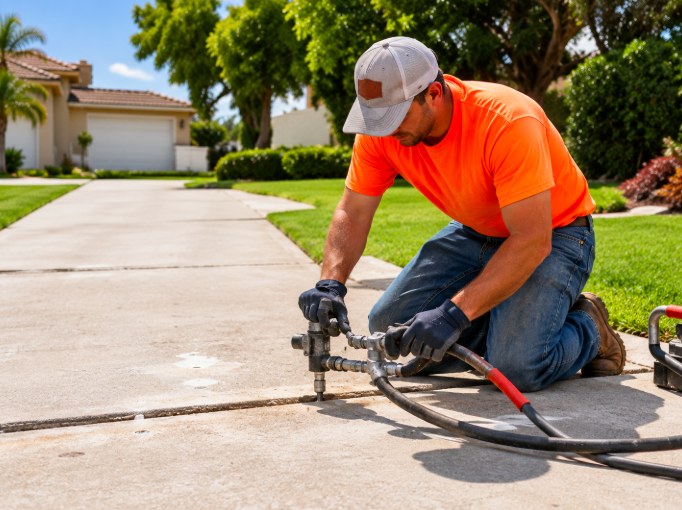
When appropriate, slabjacking or polyurethane foam injection may be used to support and elevate settled concrete.
The selected material and technique depend on the project's conditions.
After lifting, transitions and slopes are evaluated.
Joint treatment or additional drainage improvements may be recommended where necessary.
Patios installed immediately beside a home require careful attention.
The elevation of the patio must be considered in relation to the foundation, exterior walls, thresholds, drainage outlets, and surrounding landscape.
Raising a patio too high may create problems around doors or interfere with required clearances.
The objective is not simply to make the slab appear level. It is to achieve appropriate elevations and drainage for the location.
Backyard patios may contain multiple concrete sections installed at different times.
Older and newer slabs sometimes settle at different rates.
We evaluate transitions between sections and consider whether selected areas can be raised without damaging surrounding concrete.
A sunken patio can make outdoor furniture arrangements less comfortable.
Correcting eligible settlement may provide a more consistent surface for:
Concrete leveling does not automatically correct every surface defect, but it can help address some underlying elevation problems.
Replacing an entire patio may be unnecessary when only a few otherwise sound concrete sections have settled.
Leveling may preserve those sections while addressing their position.
Replacement may be preferable when the patio has extensive structural damage, widespread surface deterioration, an unsuitable design, or an underlying problem that lifting cannot correct.
A patio should not direct unwanted surface water toward the home.
If a concrete slab settles near the foundation, runoff may collect where it should not.
Before lifting a patio, it is important to identify the intended drainage path.
In some cases, patio leveling may need to be combined with drainage improvements to achieve a lasting result.
Pricing
Typical range: $1,100 – $4,200
Patio leveling cost depends on the size of the settled area and how carefully we need to work around the house, door thresholds and drainage. Keeping your existing patio in place avoids demolition, hauling and new concrete.
Prices are typical 2026 polyurethane foam leveling ranges for Torrance and the Los Angeles area, based on moderate settling (1–3 inches). You get an exact written quote after a free inspection.
Try the Price Calculator Get an Exact QuoteFAQ
Answers to common questions about patio leveling in Torrance. Have a question we didn't cover? Call (323) 471-4153.
Yes, some settled patios can be raised while the existing concrete remains in place.
Leveling and crack repair are separate treatments. Certain cracks may be sealed or repaired after the slab is stabilized.
Potentially, but foundation clearances, drainage slopes, and door thresholds must be evaluated carefully.
Age alone does not determine suitability. The condition and strength of the existing concrete are more important.
Most patio leveling projects in Torrance cost between $1,100 and $4,200, depending on the size of the settled area, how far the concrete has dropped, and access. We provide a free inspection and a written quote before any work begins.
A settled patio does not always mean your entire outdoor living space needs rebuilding.
Contact Torrance Concrete Leveling at (323) 471-4153 to explore repair options for your sunken patio.
Call or text(323) 471-415320913 Anza Ave, Torrance, CA 90503